

GETTING FISTED
Books Read, 2025

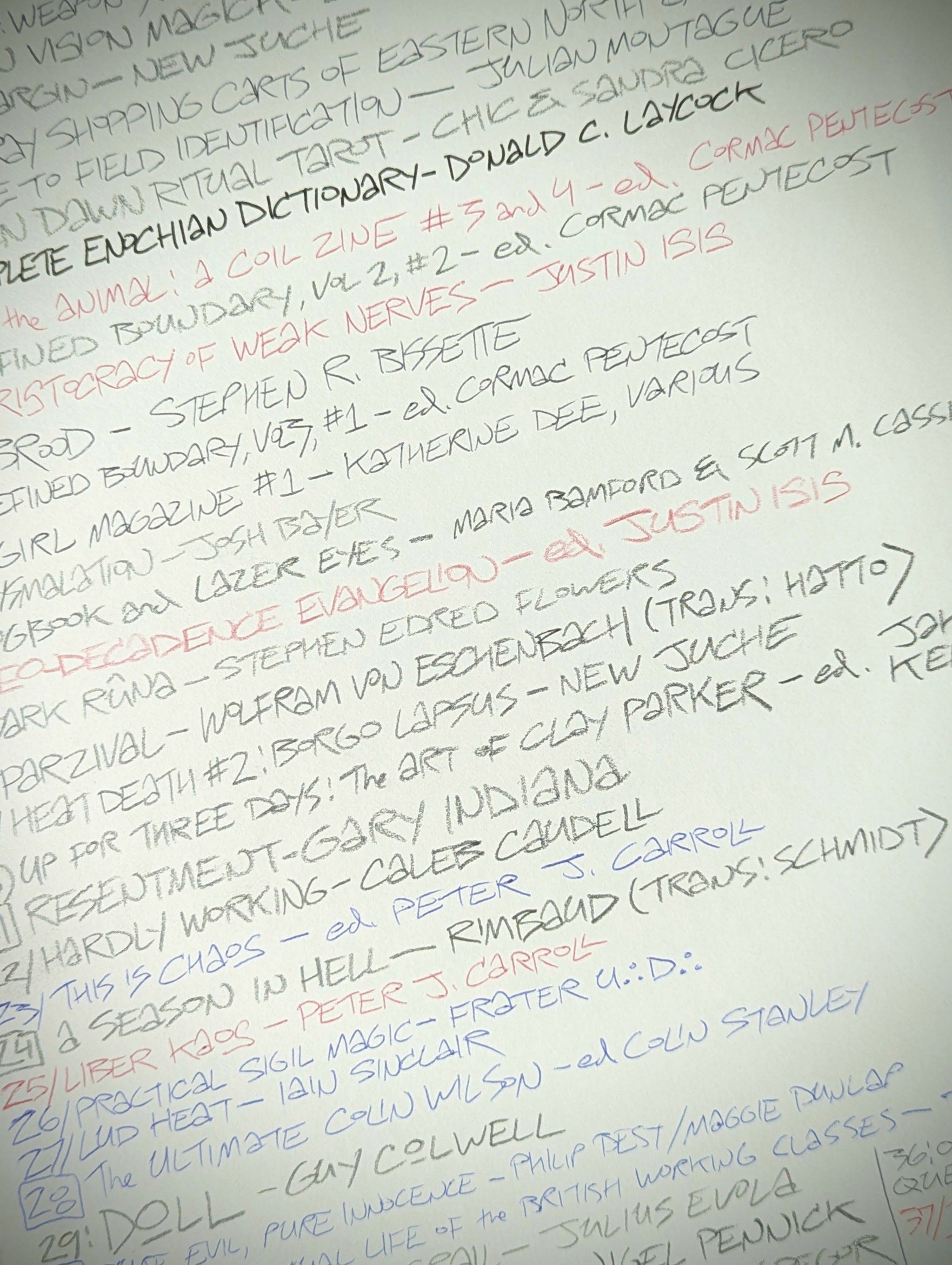
The following titles appear in the order in which I read them. The numbering in no way indicates any kind of ranking.
1) The Vessel of God, Boyd Rice
I generally like Rice’s writings and observations on pop culture, but his approach to esoteric material often turns me off; this collection of essays, which are broadly concerned with the Holy Grail mythos, is no different. Rice is clearly intelligent and knows his subject(s), but he consistently falls into an overly literalist worldview that results in Da Vinci Code-style conspiracy building. Skip it.
2) Wolverine: Weapon X, Barry Windsor-Smith
Windsor-Smith is one of the most talented artists to ever work in comics, and his Weapon X (originally serialized in Marvel Comics Presents during 1991) is a high point in an already stellar career. Unfortunately, if you aren’t familiar with or interested in the Wolverine character, the story doesn’t stand alone well, which is a shame because this bleak and borderline-experimental comic is one of the most interesting mainstream projects to come out of the 1990s.
3) Enochian Vision Magick: An Introduction and Practical Guide to the Magick of Dr. John Dee and Edward Kelley, Lon Milo DuQuette
I met DuQuette late last year and was impressed by both his charm and vast knowledge. That said, I kinda speed read through this book and will need to eventually go back and spend more time with the concepts.
4) Water Margin, New Juche
A rare glimpse into the domestic life of the otherwise enigmatic New Juche. Published by Gallows Fruit in a limited edition of 100 this year, and now sold out.
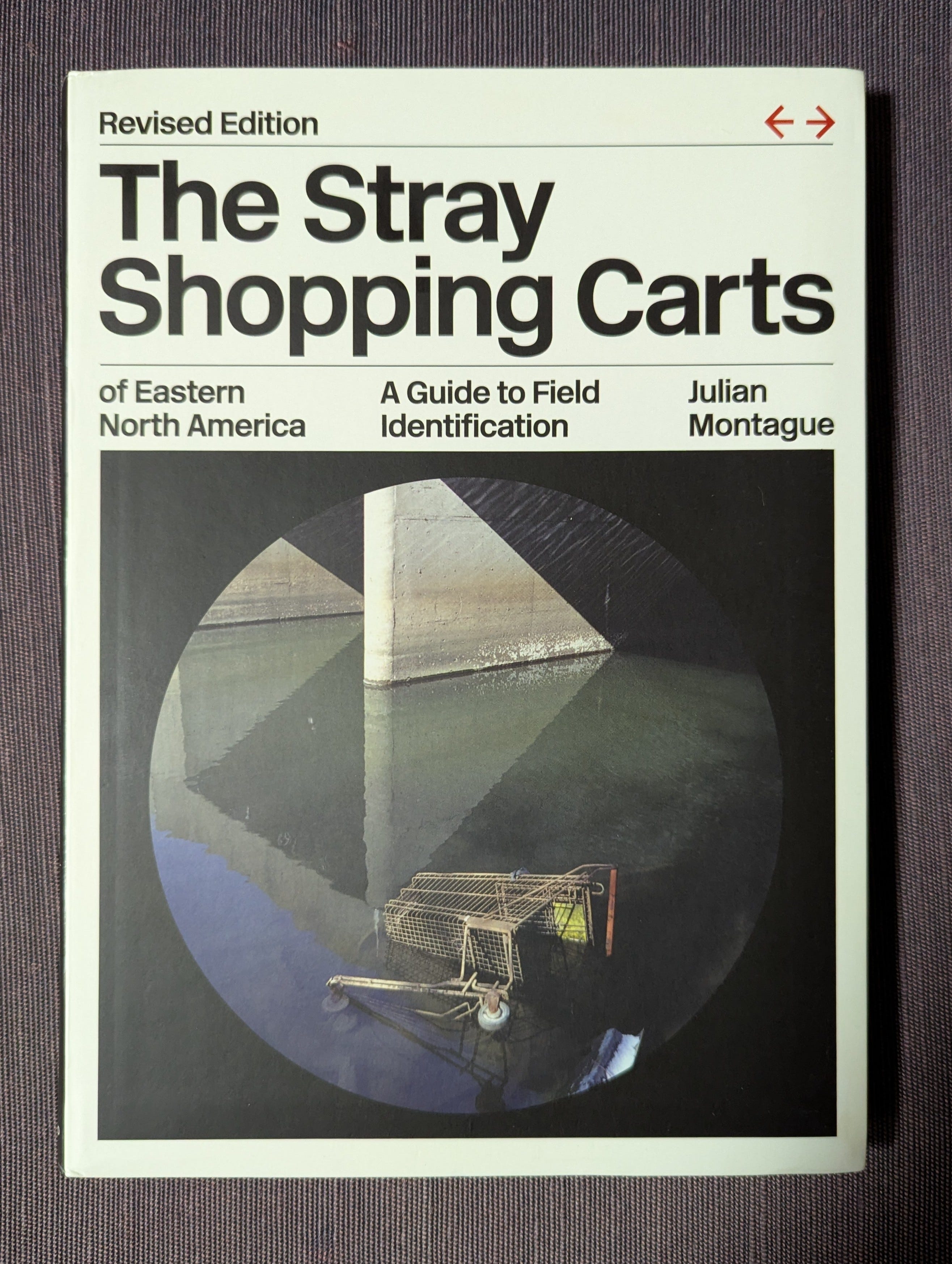
5) The Stray Shopping Carts of Eastern North America: A Guide to Field Identification, Julian Montague
Partly an art book, a dry joke, a design exercise, and a document of an intense and prolonged work of private ritual. It is also quite literally a field guide to stray shopping carts, and organizes the mundane objects into two main classes (False Strays and True Strays), along with a startling amount of sub-categories (Plaza Drift, Plow Crush, Train Damaged, Gap Marginalization, etc.). Originally published in 2006, this revised edition from 2023 is a crucial volume for individuals who prefer to pay attention to the world, not sleepwalk through it. Highest possible recommendation, a work of sublime beauty.
6) Golden Dawn Ritual Tarot, Chic and Sandra Cicero
The “standard” Rider-Wait tarot is based upon Golden Dawn ideas, but as it was never intended for the uninitiated, various details and nuances were omitted. For anyone interested in an undiluted examination of the GD system, the Cicero’s guide is an essential text.
7) The Complete Enochian Dictionary, Donald C. Laycock
The bulk of this book is exactly what it claims to be: a “dictionary of the angelic language as revealed to Dr. John Dee and Edward Kelley,” along with the complete Enochian Calls and a detailed bibliography. In addition to such occult reference materials, there is also seventy pages of introductory texts.
8) Man is the Animal: A Coil Zine #3 & 4, ed. Cormac Pentecost
Coil has slowly become one of my favorite musical projects, and anyone with an interest in the experimental band should appreciate this journal from Temporal Boundary Press .
9) Undefined Boundary Vol.2, #2, ed. Cormac Pentecost
More from Temporal Boundary. I always enjoy this publication.
10) The Aristocracy of Weak Nerves, Justin Isis
Beautifully printed and contains two mind-blowing short stories by Isis. Published this year by Occult Press in a limited edition, and unfortunately already sold out.
11) The Brood, Steven R. Bissette
A detailed examination of David Cronenberg’s 1979 horror masterpiece The Brood… as written by legendary Swamp Thing artist Stephen R. Bissette. If this sounds too good to be true, it is. Clocking in at nearly 700 pages, the author abandons any pretense of thematic focus and instead spends his (and the reader’s) time rambling through every possible digression and tangent, including endless plot summaries of films with alleged similarities, and punishingly detailed explanations of the minutiae related to Canada’s old film tax shelter policies. This book crushed my spirit and defeated me somewhere around page 200. With some severe editing, The Brood could have been a decent monograph, so Stephen, if you’re listening: SOMETIMES LESS IS MORE.
12) Undefined Boundary, Vol.3, #1, ed. Cormac Pentecost
A solid issue of this Anglo-centric journal. Contains writings about Kate Bush, the eccentric Peter Whitehead, and occult-infused episodes of otherwise bland British TV detective dramas (!!!). There’s more of course, but what else do you need to know?

13) Egirl Magazine #1, Katherine Dee, various
Beautiful artwork on every page, with a continuous timeline text scroll along the top, which offers a succinct history of the “e-girl” (electronic girl) social phenomenon. Published this year by 2dcloud, and highly recommended.
14) Abysmalation, Josh Bayer
A nice odds-and-ends collection from 2022 with various short comics and illustrations by one of the most unique voices working today. I’m happy to report that Church Ghost is currently developing some projects with the iconoclastic Bayer, so stay alert for more news concerning that in 2026.
15) Hogbook and Lazer Eyes, Maria Bamford and Scott M. Cassidy
Maria Bamford is an undeniably singular performer, and I admire her work—but her talent for the stage does not translate to the page, and this graphic novel is sentimental puppy-parent dreck, and drawn in a flat faux-cute style that has become suffocatingly ubiquitous in alternative comics. Forgetting my own particular tastes and quirks, Hogbook and Lazer Eyes is objectively flawed, and downright lazy: Bamford couldn’t even bother to write a proper ending, and the book (which was already dull and laced with middleclass neurosis) just trails of suddenly like an unfinished thought. If you see this book in the wild, break the spine, tear out the pages, and send Fantagraphics a curt note voicing your displeasure.
16) Neo-Decadence: Evangelion, ed. Justin Isis
Undeniably the best anthology collecting Neo-Decadent fiction. Published by Zagava in 2023, and unfortunately now out-of-print. The good news is that Damian Murphy’s contribution, “A Night of Amethyst,” will be reprinted in a new solo collection by Church Ghost in early 2026.
17) Dark Rûna, Stephen Edred Flowers
Flowers, aka Edred Thorsson, is best known for working in the field of neo-paganism, but this particular collection of older writings is culled from an internal publication of The Temple of Set’s Order of the Trapezoid, so the overall angle is explicitly of the “left hand path” variety. A cheap and simple book, but full of interesting essays—“Runic Origins of the Peace Sign” being just one example.
18) Parzival, Wolfram von Eschenbach (translation, Hatto)
This is it, the looming and intimidating Grail legend, and dark counterpart to the comparatively straightforward Le Morte d’Arthur. Both Malory and von Eschenbach pick up where Chrétien de Troyes stopped short due to death, but the German takes things in a strange and Luciferian direction. Parzival is practically the primary source for all Grail weirdness, be it mysticism, conspiracy, or both; as such, this is required reading for anyone interested in such matters. It’s a challenging text, even as a modern prose translation, but it’s also deeply rewarding for anyone willing to put in the work.

19) Heat Death #2: Borgo Lapsus, New Juche
While the first Heat Death explores an abandoned post-Covid tourist island off the coast of Thailand, this second issue is situated on the island of Sicily, where Juche investigates the landscape (and remnants of Fascist architecture) through photographs and visionary text. This is beyond “travel writing,” and I wouldn’t be surprised if hell itself served as the location for the next entry of this important series.
20) Up for Three Days: The Art of Clay Parker, ed. Jake Kelly
A passion project by Jake Kelly, which collects the poster art and comics of Cleveland wild-man Clay Parker. Also includes a wide-ranging interview which captures the artist’s twitchy energy. Published this year and available from Kelly’s own press, Pave the Ocean.
21) Resentment, Gary Indiana
Contains the most distressing description of sexual violence/fisting I’ve ever encountered—and yes I’ve read Delany’s Hogg.
22) Hardly Working, Caleb Caudell
Sharp auto-fiction from 2024, penned by a cranky Midwesterner with a badly-functioning dick and even worse career prospects. Hilarious rants puncture woke shibboleths while also providing keen insights into the service industry salt mines of late Capitalism. In a better world, Sam Rockwell would be slated to play Caudell in a new Netflix series, and everybody who supported the book early on would get fucking rich from royalties too.
23) This is Chaos, ed. Peter J. Carroll
A new collection from Weiser Books, with a diverse selection of essays concerning Chaos Magic, and illustrations by the great Hagen von Tulien.
24) A Season in Hell, Arthur Rimbaud (translation, Schmidt)
It’s a little embarrassing that I just got around to this poem at age 44, but better late than never.
25) Liber Kaos, Peter J. Carroll
The first chunk of this book leans hard on advanced science (or arguably pseudo-science), a subject of which I’m in no position to pass judgment. If you’re interested in Carroll or Chaos Magic, this is not a good starting point. Liber Null & Psychonaut, by the same author, is a much more accessible introduction, and considered a classic for good reason.
26) Practical Sigil Magic, Frater U∴D∴
I’m suspicious of anybody who calls themselves “Frater” (at least outside of very specific ritual contexts), but I guess “Ralph Tegtmeier” just doesn’t sound badass enough. Anyways, Ralph was a major figure in the so-called “Ice Magick Wars,” and is therefore somewhat controversial. Despite (or because of) this, his book on sigil magic seems to be highly regarded, a fact which doesn’t speak well of the competition. One of the worst sins on display is the book’s first chapter, “Austin Osman Spare and His Theory of Sigils,” which is an older magazine article, but reprinted here verbatim. There’s nothing wrong with an author cannibalizing their own work to form a larger book, but the practice generally involves a modicum of editing so the material flows seamlessly. Then there’s Chapter Nine, “Constructing Sigils with Planetary Cameas,” which gets off to a false start because the technique requires “knowledge of cabbalism and planetary magic” which “cannot be taught here and would lead away from our main topic.” Then why’d you bring it up, Ralph? The book is only 138 pages, surely he could have squeezed in a summary. The bulk of the book, however, is concerned with Spare’s invented technique (while traditional sigils are largely ignored), and the presentation is indeed clear, unlike the original writings; Spare may have been a brilliant visual artist, but his words were exceptionally convoluted. Such writings were first clarified by Kenneth Grant, whom I’ve never read, but from what I understand he could be oblique and difficult too. With all that in mind, Ralph deserves credit for wading through these older texts and creating something that’s accessible to the general reader. But maybe these techniques would be better left obscured? Perhaps the psychosphere would be less cluttered with the half-assed operations of TikTok witches if the methods were still sufficiently arcane. Ultimately, the approach of sigil magic (when combined with sex magic) may have been best summarized, by London-based reasearcher Madeleine Le Despencer, in an offhand Facebook post: “Jerk off and make a wish.” But truthfully, aren’t we all guilty of this sometimes?
27) Lud Heat, Iain Sinclair
This was a re-read for me. Mysterious, fascinating, and one of my all-time favorite books.
28) The Ultimate Colin Wilson, ed. Colin Stanley
Wilson interests me, but this collection (mostly non-fiction excerpts) was kind of disappointing and full of redundancies. Still, for a crash course of the man who wrote The Outsider and The Occult, this book is not without value.
29) Doll, Guy Colwell
What a strange book Doll is. I’d been curious about it for years, but finding all the original comic book issues by Colwell was no easy task, and this difficulty probably served to amplify the title’s notorious reputation. Produced in the late ‘80s and early ‘90s, the serialized storytelling and drawing style are of a type that is now practically extinct. If Doll could be compared to anything, it would be the relatively contemporaneous Omaha the Cat Dancer—but where that title was often joyous and celebratory in its depiction of sex and sexuality, Doll is the complete opposite. With page after page of hardcore illustrations, the sex is uniformly mechanical and compulsive in a way that approaches clammy-skinned “body horror.” The story itself—something of a picaresque fable—concerns the journeys of a realistic sex doll, and the various lost souls who cross “her” path: a rogue’s gallery of misfits, pseudo-intellectuals, pornographers, social climbers, and—most importantly—proto-incels. Yes, this book was ahead of its time; so much so that one briefly appearing character (who tries to make a male doll and just ends up with a scarecrow sporting a dildo) could even be viewed as a proto-femcel. Doll would be absurd as a film or novel, but for reasons that are hard to articulate, the ideas and generally weird tone fit well within the context of a late-era underground comic with a counterculture hangover. Doll is both artifact and almost-masterpiece, and this relatively recent collection from Fantagraphics deserves far more attention and discussion. On second thought, the idea of cloying academics writing ponderous papers about Doll is enough to make my stomach churn. Maybe Doll is fine where she is—with the creeps and the perverts.
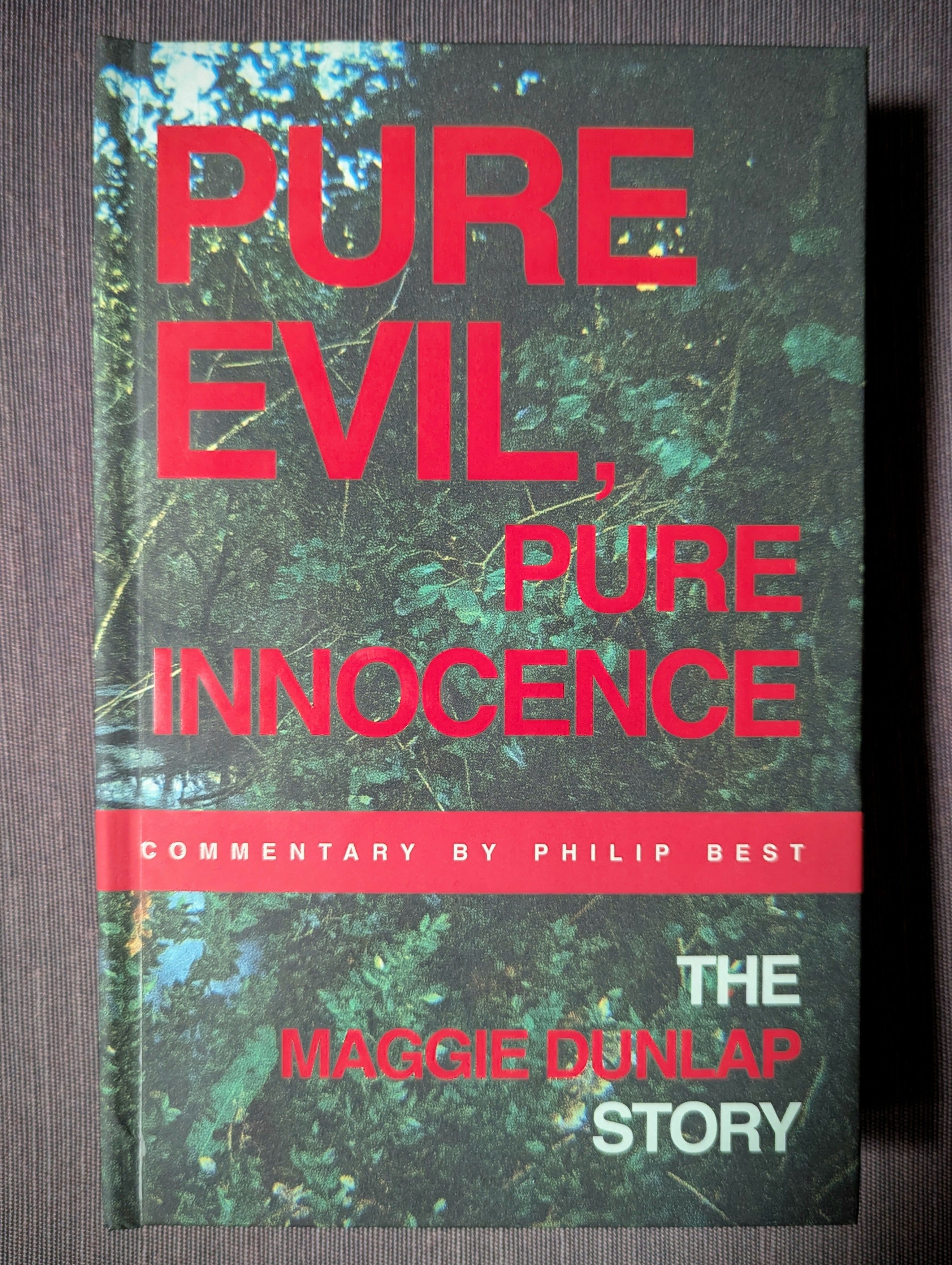
30) Pure Evil, Pure Innocence, Philip Best and Maggie Dunlap
I was expecting an art book by Dunlap with “commentary” (as advertised) by Best, but the reverse is more accurate: Out of the over-500 pages there are only 88 plates/illustrations by Dunlap and the rest of the book is machine-gunning text. So, what exactly is Pure Evil, Pure Innocence? Per the house style of Amphetamine Sulphate, little context is given, but it would seem that Dunlap specializes in creating fake (but realistic) “true crime” photos, while Best does a cut-and-paste job with various true crime sleaze, but peppered with his own original writing. Inscrutably, and for reasons probably only understood by the author, this large hardcover also includes reviews of various bootleg records, often related to ‘70s rock acts (???). With so many pages, and such an experimental nature, I was worried this book would be a chore—to my surprise, it was strangely hypnotic and I fell into the flow easily. If there’s an avant-garde within the true crime genre, then this is it. Published this year in a limited edition.
31) The Intellectual Life of the British Working Classes, Jonathan Rose
The introduction (new to the third edition, 2021) and the closing section “What Went Wrong,” should be required reading for anyone who’s wondered how we went from the printing press to post-literacy in less than six centuries. Unfortunately, the large middle of the book (total of over 500 pages and with VERY SMALL type) is much more challenging, and despite the promises of the cheery back cover blurbs, hardly suited for a non-academic reader. Don’t get me wrong, the scholarship on display here is a towering achievement; and while I eventually resorted to merely skimming, I will be keeping this book for future reference (thankfully there’s an index).
32) The Mystery of the Grail, Julius Evola
Despite his many associated controversies, the Fascist-mystic Evola knew his stuff. This particular title has some goofy (and assuredly unpopular) ideas about gender, but if you can look past that, The Mystery of the Grail contains plenty of insights for anyone interested in the subject.
33) Runic Lore and Legend: Wyrdstaves of Old Northumbria, Nigel Pennick
Pennick is always good, and this particular title explores the often overlooked Anglo-Saxon and Northumbrian additions to the runic alphabet, along with associated ideas and related folklore. This title pairs well with the similarly-minded Just Add Blood, by Kennan Elkman Taylor. Both titles served as useful reference for an illustrated section of the book I’ve been working on, Peppermint Werewolf: Wasteland, which should be completed in a year or two.
34) The Wholeness of Nature, Moïna MacGregor
A slim chapbook containing rare writings by the wife of Samuel Liddell MacGregor Mathers, one of the founders of the Hermetic Order of Golden Dawn. Published in 2025 by Occult Press in a numbered edition of 100, this little gem is already out-of-print.
35) The Middle Pillar, Israel Regardie
On the whole, Chic and Sandra Cicero’s interpretations of Regardie (and the larger Golden Dawn project) are much more accessible and easy to digest than the Victorian-flavored primary sources. But it’s worth having earlier texts on hand for cross reference, and The Middle Pillar can be found be found both easily and cheaply.
36) Out There, Quentin S. Crisp
A solid piece of Japan-set fiction by Crisp, and slapped between a nice hardcover with the quality production you can always expect from Occult Press. Very limited edition so get it while you can.
37) The Chaonomicon, Jaq D Hawkins
Very much a self-published affair, The Chaonomicon reads like a loosely assembled collection of blog posts. That said, Hawkins provides some firsthand anecdotes concerning the early Chaos Magic scene, and her female perspective is a welcome addition to this often male-dominated field of interest.

38) The Complete Crepax Vol.8, Erotic Stories Part II, Guido Crepax
This is the second collection of the Italian cartoonist’s erotic work (I skipped the first, because I already have most of the material in earlier editions) and included here is a coldly elegant adaptation of the notorious Story of O. Just totally brilliant and innovative work, almost every page is a masterpiece. Available from Fantagraphics (okay, so maybe don’t send them your Hogbook and Lazer Eyes hate mail).
39) Selected Amazon Reviews, Kevin Killian
Not just a clever title. This large book (published 2024) collects a vast selection of the late LGBT poet’s actual Amazon reviews, which range from serious critiques of film and literature to off-the-cuff musings about mundane household products. (Also frequently mentioned/reviewed: Kylie Minogue.) A strange project, and probably the closest thing to a “bathroom book” that Semiotext(e) has ever published.
40) Shame, Wolf Margolies
Even by my own louche standards, former rapper Wolf Margolies is undeniably “problematic.” But the circumstances pose an interesting question: Is there any sense in “cancelling” someone who has already been held accountable in the strictest possible way? You see, Shame was written from behind bars, where Margolies is in the early phase of a rather long prison sentence. You can google the sordid details for yourself, so let’s stick to the 2024 book, which raises our second question: Is it any good? The answer is “not really.” The slim volume blends various influences, including Last Exit to Brooklyn, Larry Clark’s 1995 film Kids, Sadean philosophical interjections, and even (quite randomly) poorly developed nods to the druggy sci-fi paranoia of A Scanner Darkly. And if that’s not enough, there’s also illustrations which are reminiscent of Pheobe Gloeckner’s visual contributions to the RE/Search edition of The Atrocity Exhibition (I guess I now own TWO books with cutaway blowjobs done in the style of medical illustrations). I probably would have been impressed by Shame in my twenties, but as a SOPHISTICATED ADULT I found a lot of this to be juvenile and undercooked. The philosophical sections clearly aim to elevate the proceedings above the rest of the vile content (fisting, KP, rape, overdoses, general abuse) but sadly these ideas can basically be reduced to red-pilled Social Darwinism. Yes, Wolf, we are all animals and programmed to fuck; and if I deny this then surely I am a hypocrite and a slave to conformist morality—but which one of us is in prison?
That’s the last book of the year, and I don’t want to end on a downer. So let it be said, the publisher of Shame, Infinity Land Press, can generally be counted on to produce thoughtful books of exceptional quality, and they have my highest respect. Additionally, they’ve recently reprinted their newly translated (and lavishly illustrated) edition of Lautréamont’s The Songs of Maldoror, of which I’ve only heard great things.
If you enjoyed this post, please consider a paid subscription. Your support goes a long way in helping the variously mundane and brutal costs which make running a small press such a challenge. For reasons both broad and personal, 2025 was a difficult year, but I’m optimistic about the future and have a good feeling about 2026. Merry Christmas and happy New Year.

Thanks for the kind and perceptive review. The bootleg recording reviews often relate to crimes committed at / or on the day of the shows, and on a broader level, 70s rock stars remind me of so-called golden era serial killers living out their final days, either lugging their carcasses around the world's stages, or forgotten and drooling in penal solitude, a world away from their heyday. Great list overall as well. Cheers PB
woaaah will definitely check so many of these out. the stray shopping carts book definitely reminds me of the fake organization HORG, which classifies bread clips