

BLONDE RED HEADS
Tim Wright in New York

A hundred times I have thought: New York is a catastrophe, and fifty times: it is a beautiful catastrophe.
—Le Corbusier, When the Cathedrals Were White
My cinnamon Danish is fine—sticky-sweet—but I don’t understand the fuss. The coffee is equally unremarkable, but I’m not complaining, as I don’t like remarkable coffee. Josh Bayer recommended the place, and he walks in with his muscles, headphones, and tangled layers of clothing including a t-shirt that says “Heroin.” He joins me at the table, a table I was lucky to nab, as I’ve got the sense this Hungarian bakery is trendy amongst the natives of the Upper West Side—or in Josh’s case, nearby in Harlem. We haven’t seen each other since I left the East Coast over eight years ago (though there’s been plenty of phone calls and messages in the interim) and we start yacking at each other as we spike upwards on morning caffeine.
Josh tells me that his brother directed the “Smells Like Teen Spirit” video (I did not know this), tells me about an annoying interaction with a polyamorous woman, tells me about this and tells me about that. He reaches for my pen and notebook as he speaks, scribbling mysterious cartoon diagrams to illustrate his points, to make himself clear. I take my pen back and I tell him about the purpose of my visit, tell him that I’m staying in a haunted apartment, a dead man’s apartment. I tell him about Tim Wright.
It’s kind of complicated.
Tim Wright and his partner Mary Ann were the dark gothic duo of Cleveland Heights. I’d watch them glide down Coventry like cats, both tall with incredibly long hair, always dressed in black, guitar cases in hand.
—Adele Bertei (Contortions)
Tim (bass and/or guitar—it gets a bit confusing) was a founding member of Pere Ubu, along with Peter Laughner (mostly guitar but also bass). The two were often described as best friends, and together they appeared on “30 Seconds Over Tokyo” / “Heart of Darkness” and “Final Solution” / “Cloud 149.” Peter then left the group and Tim stuck around just long enough to appear on “Untitled,” an early version of “The Modern Dance.” After Ubu, Peter had some other projects and then drank himself to death; Tim left the country, then returned to Cleveland, “fucked around”… then landed in New York, took out an ad, and joined DNA.


Tim and Mary Ann
Me, I arrived in New York last night; landed in Newark, took the train to Penn Station, and then Uptown—where the subway car had an ad for Father Mother Sister Brother, the new Jim Jarmusch film; something I would never see on a bus in Cleveland, despite the fact the Jim is from nearby Cuyahoga Falls. I’m in town because several weeks ago I was contacted by an Iranian named Rene, who was a neighbor and close friend to Mary Ann, and he informed me that she had passed away. Tim, her husband, died back in 2013—before Rene moved into the building—but I was informed that Mary Ann kept everything, and as a sort-of biographer of Laughner, Rene thought I might be interested in coming by to see the apartment. I never got to talk to Tim either, as his death preceded my Laughner research, and I was always deeply curious about him. I was told I could stay in the apartment, and since I was able to find a direct flight for 200 bucks, I agreed to make the trip. Maybe I would find some answers.
Rene and a friend met me on the street, then we went up to Tim and Mary Ann’s old place—apparently, years ago, Brian Eno visited them here; Tim appears on Bush of Ghosts, but I got the impression that Tim eventually told Eno to fuck off. Rene starts showing me around—there’s stuff everywhere—and mentions an interview he found between Tim and “James Jarmusch.” I say it’s probably Jim, that he once interviewed Ubu. “I’ll have to ask Jim about that,” he says. Rene seems to know a lot of people—he “knows Dascha,” he saw Gasda’s Dimes Square—and on a lark I asked if he had any Vincent Gallo anecdotes. “Ha! I don’t know HIM, but we’ve definitely been in the same room.” Sitting on a nearby table, there’s a copy of The Magical Diaries of Aleister Crowley—a confirmation of some of my suspicions.
In the Hungarian bakery, I try and explain all this to Josh. I know he has my Laughner book, because he asked me to send him a copy—I don’t think he’s read it, and that’s fine, I haven’t read all his books either—and he nods ands says “I should really listen to more Pere Ubu.” “Well,” I shrug, “they aren’t for everyone.”
Josh has to split for a morning class, so I cut over to Central Park, begin by walking down the western edge. I’ve got a list of landmarks on a hand-drawn map and I’m looking for Adventure Playground… but I hit the Maine Monument at the park’s southwest corner, so I’ve clearly missed my mark, need to backtrack.
Stumble into a little “Imagine” memorial area (Strawberry Fields) with booths selling cheap Beatles trinkets, near a milksop playing “Let it Be” on acoustic. I figure the Dakota is nearby, remember a Cranberries lyric—I just shot John Lennon / He said, I just shot John Lennon—remember seeing a book about John on one of Tim’s cluttered shelves. Was he in NY when Chapman pulled the trigger? Or was he off in Central America or some other far-flung exotic locale? Because that’s what Tim liked to do: travel. There’s evidence of this all over the apartment, and not just tourist bullshit: maps for Paris, Mexico City, Buenos Ares; a passport with a suspicious amount of Columbia stamps; a brochure for “Adventure Tours” in Caracol, Xunantunich, Cahal Pech, El Pillar, Pacpitun, Tikal; there’s even a Belize driver’s license issued in 1999 (in the photo, Tim looks puffy and alcoholic).
…whisper words of wisdom…
I like The Beatles, but this mawkish circle is gross and pathetic; I must return to my obscure itinerary.
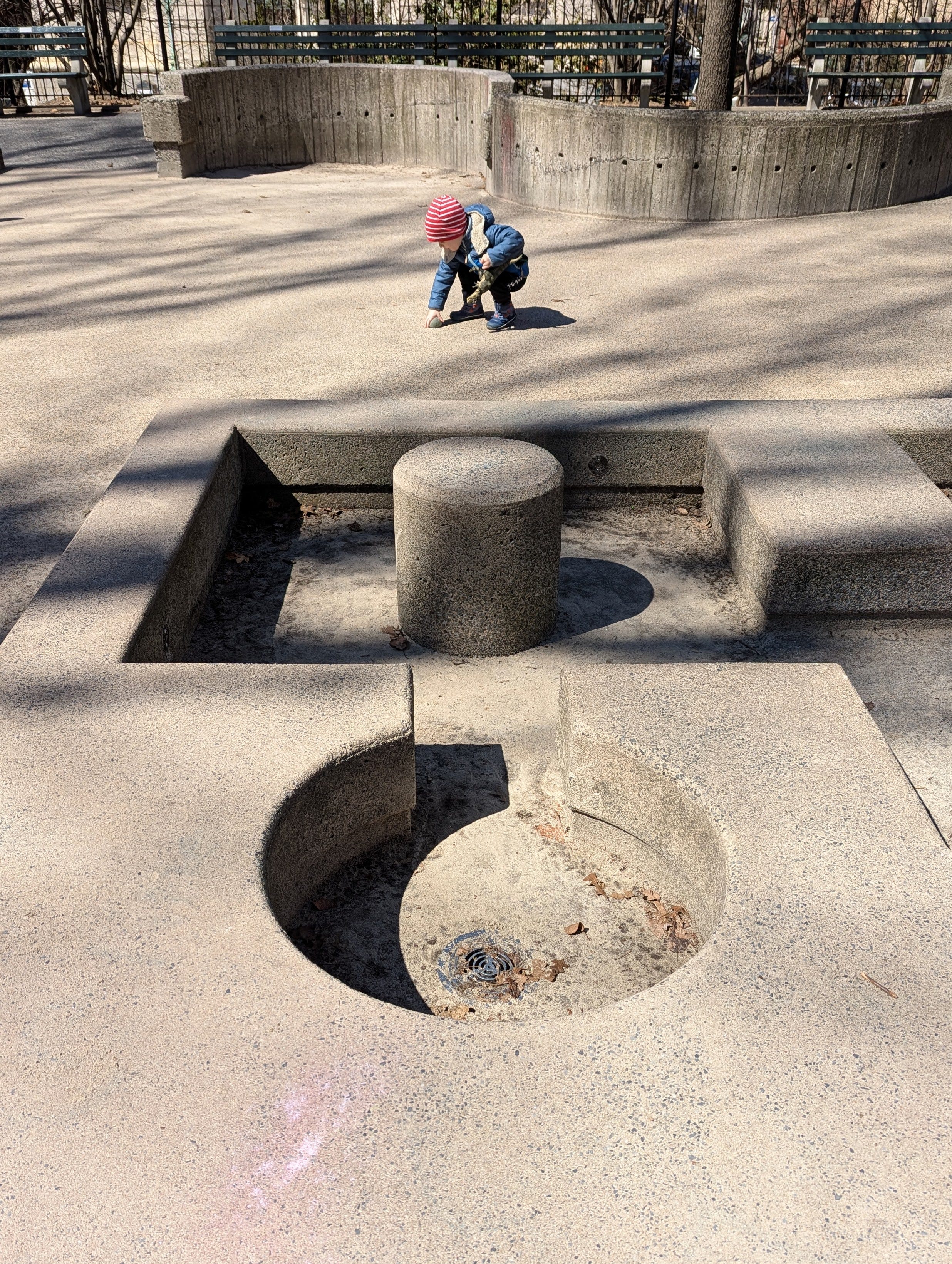
Adventure Playground was designed by Richard Dattner in 1966, and marks a clear division from the earlier Robert Moses period, as this is the park’s first modernist playground; made largely of concrete (!!!), it could even be considered Brutalist. After some difficulty I locate the tucked away play area, with its stepped pyramid and canal-like grooves. A child gallops to the beat of the bass line—bhum-bhum-bhum-bhum—from “Final Solution,” and I consider skinned knees and Debbie Harry getting raped at knifepoint during a home invasion; Chris Stein was forced to watch.
Adventure Playground
Their songs are sometimes very short, but always intense. Each one distills a mood. They move from mood to mood, sketching the lush, awesome hinterlands inhabited by the modern emotional primitives of the asphalt jungle.
—Glenn O’Brien talking about DNA, Interview magazine
***
Cross the park… in the vast middle area… there’s 40-plus women in overcoats, walking their overly manicured dogs—these dogs, these women, are pure creatures of New York, and would be brutalized and savaged quickly in any other environment. There’s no grid—here she comes—and it’s easy to wander in circles—here she comes—but the locals walk with sure steps—she’s okay—and it looks/feels—she’s okay—like “Cloud 149”—I can tell…
This whole park was designed by Frederick Law Olmsted… who also designed the Fine Arts Garden, back in Cleveland, outside the art museum. There’s museums near here too, near Central Park, and I tell myself I’ll visit one tomorrow. But for now there’s no hard destination… and I stop and look at any outdoor sculpture that catches my eye: a carved granite Mother Goose, two eagles attacking a goat.
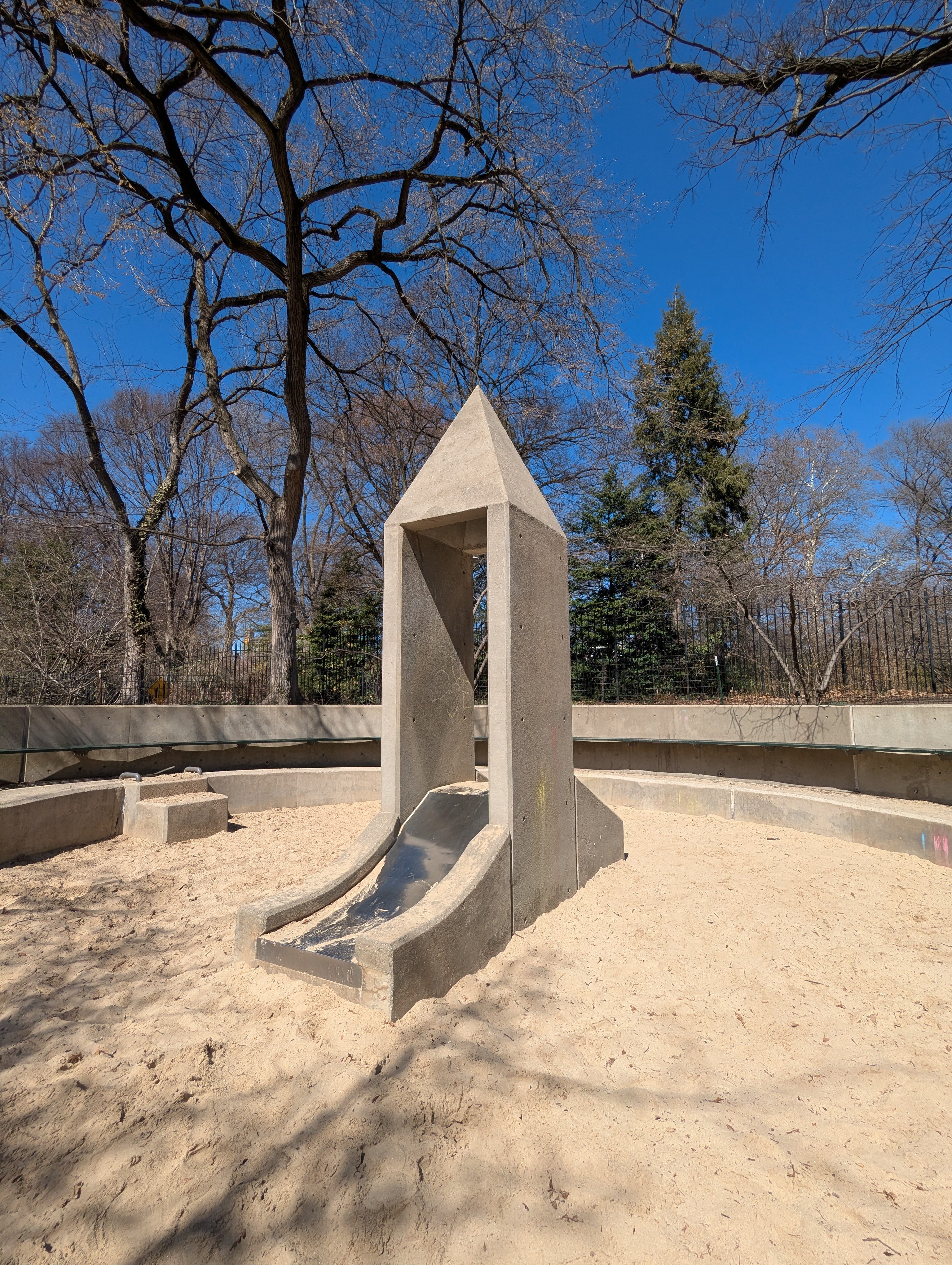
Then there’s E. 72nd Street Playground (closed for maintenance), another Dattner, and one of several “adventure-style” areas in the park, and part of the unexpected concrete/Brutalist subset. I can’t get in here, but further along I have luck at Ancient Playground; Dattner strikes again, and this time he takes inspiration from the nearby Met’s Egyptian collection—specifically the Temple of Dendur—and designed the playground to evoke an ancient city, including a concrete obelisk with a metal slide.
Ancient Playground
Rene told me, “I asked Mary Ann what Tim did for the rest of his life after DNA broke up. She looked perplexed by the question before settling on an answer. ‘Something like an archeologist, I guess.’”
Elliott Sharp: Did your friend, the bush doctor in Belize, have any knowledge of skull forming or trepanning? Aware of its tradition?
Tim Wright: No. A lot of traditions he’s unaware of because he’s spent all of his life in a very small radius and all of his knowledge he’s gotten first-hand from someone or from visionary experience. His practice aside from herbal medicine involves a complex system of astrological magic, astral projection, the classic shamanic experiences, invocation of supernatural sights and sounds. He has had some experience with people who do teleportation or appear to do so.
—Publication title unknown, 1984
What would Tim have thought about Ancient Playground; about Dattner’s “ancient city”? Like all good hipsters, he and Mary Ann didn’t have children. Were they even aware of these strange Brutalist islands, or did they just hustle by? One thing I am sure of: they knew “Cleopatra’s Needle.”
Located near the playground, behind the Met, this is the real deal. This Obelisk was created around 1425 BCE in Heliopolis, Egypt. A 220-ton monolith, a single piece of stone carved out of granite at the quarries of Aswan, and one of two obelisks commissioned by Pharaoh Thutmose III for the Temple of the Sun. Originally, the pinnacle would have been covered in gold, gold, gold.
There is a latent religion and a mythology in these diffuse landmarks—a Brutalist slide, Mother Goose, a genuine obelisk—begging to be assembled and mapped into something coherent. I feel like DNA and Ubu at times understood this, were trying to form a new language, were trying to dance about architecture. A girl walks by on her phone and she says “it’s not a big deal, my mom will lend me 20k.”—here she comes— The dog walkers are oblivious, and only the tourists pay attention but they are looking at all the wrong things—there she goes—looking in the wrong way; I want to play them “Cloud 149”—uh, uh, uh, uh, uh—I want to force them at gunpoint to learn and memorize Cleopatra’s hieroglyphics… but all I do is text Avi Spivak and tell him I’m at the Big-Dick Egyptian Magic Sun Needle.
“Cool.”
***
Avi is catching the Red Line, so it makes sense to meet him on the other side of the park—my Chelsea boots are starting to get a real workout—so I start zigzagging over there, get a soft pretzel en route, then find a bench on Central Park West.
Avi used to work for Miriam Linna at Norton Records. The Cramps’ first drummer and originally from the CLE area, Miriam’s name appears in cursive in an old address book in Tim’s apartment. I flipped through it last night and saw: “Peter + Charlotte” (Akron address), Charlotte without Peter (CLE address), Peter without Charlotte (Bay Village address), and “T. Herman” (Tom Herman, Pere Ubu: phone #, no address)… along with other mysterious entries like “Brett’s friend Terry.”
I pull out a copy of Nick Tosches’ Hellfire, which Avi actually recommended to me years ago, and then he arrives and we walk around the park for a bit—stand on a high rocky bluff, discuss astronaut calisthenics—and then go over to the apartment and Rene meets us.
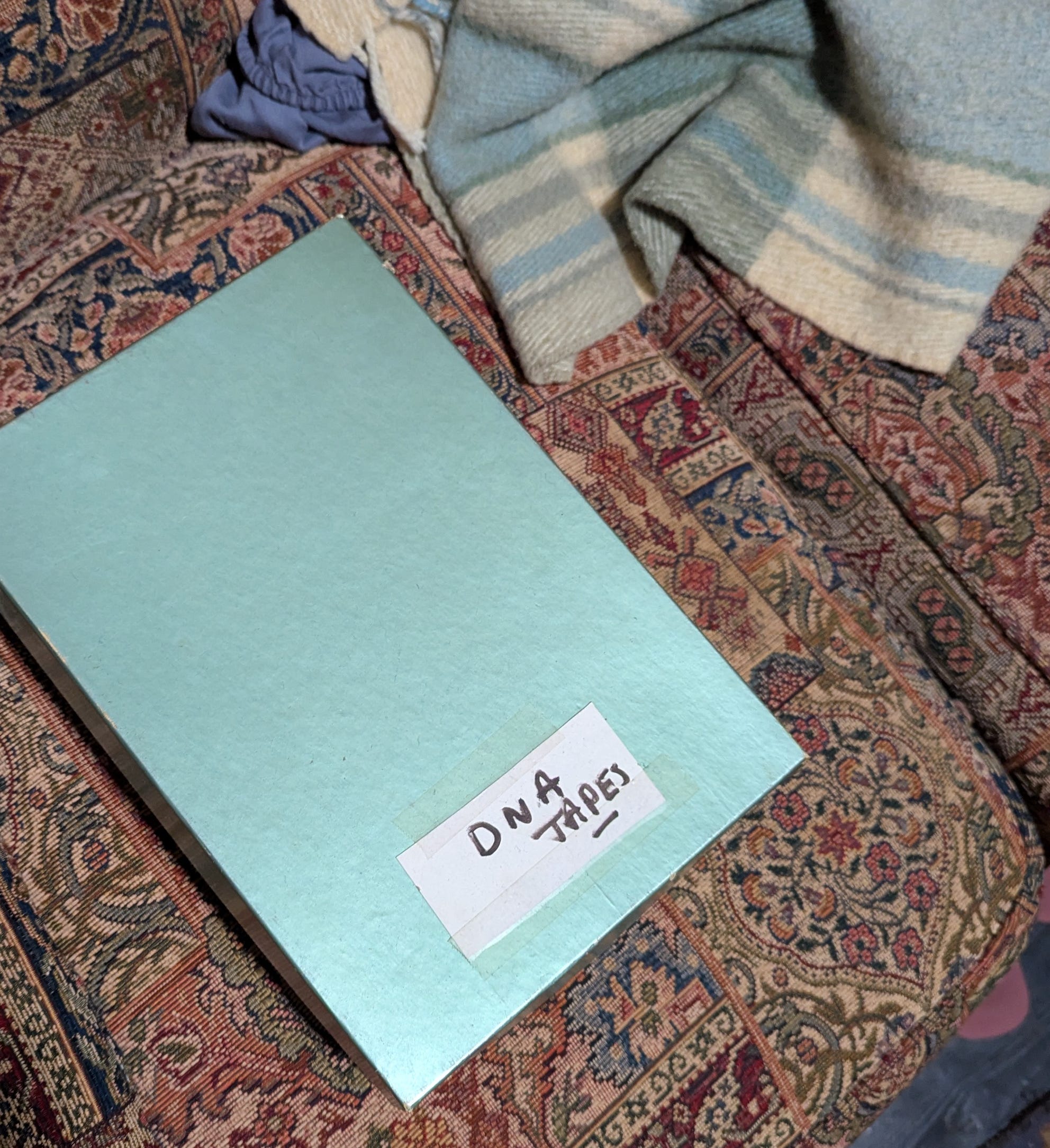
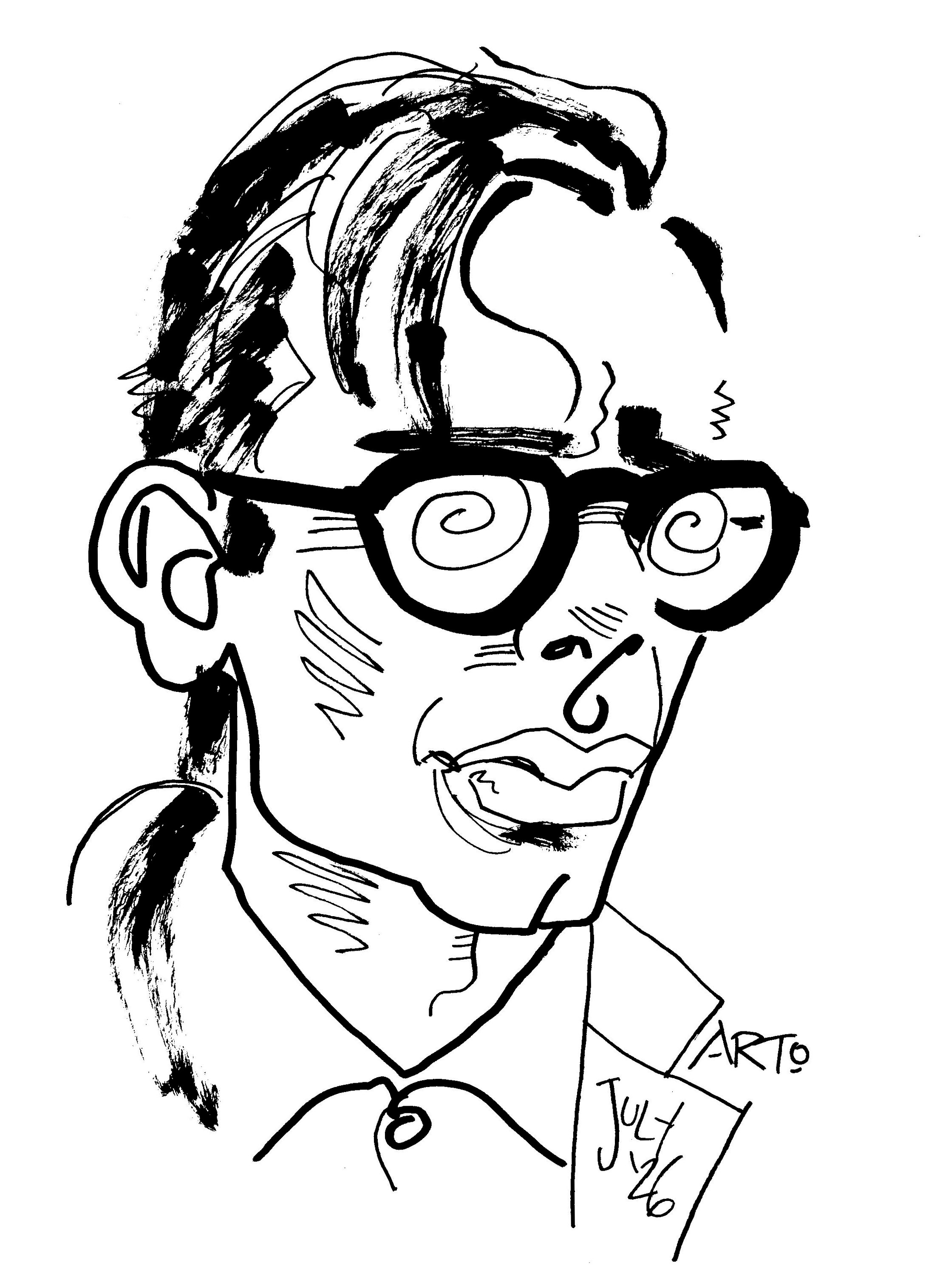
Rene likes showing off these artifacts and Avi has a nose for this stuff—digging around he quickly finds the master tapes for “30 Seconds” and then a manila folder full of DNA fliers. There’s also a stack of sealed copies of DNA on DNA, a comp from 2004, and Rene says “take one.” There’s no room for the double-LP in my carry-on luggage, so Avi tucks one in his bag, says he’ll mail it to me later. Avi negotiates to purchase some items, recommends some book buyers, points out a large heavy table—says it’s in the Arts and Crafts style. We sit down and relax and Rene puts on one of Tim and Mary Ann’s old answering machine tapes, a time capsule of the old Downtown scene: people looking to jam, looking to score. The voices include Jean-Michel (Basquiat), Zoë (Tamerlis Lund), and Arto (Lindsay)—who starts one message with a percussive “Tim-Tim-Tim-Tim!” Looking at old photos, I comment that Arto looks like an adult version of the thick-lipped kid from Persona. Rene’s eyes light up—“He does!”
Arto: From the author’s sketch book
Dinner of Chinese noodles and early to bed. The bed where Tim slept…
There are two undeniable musical masterpieces to come out of Cleveland. One is Andrea Carroll’s “Please Don’t Talk to the Lifeguard,” and the other is “Final Solution.” Tim was on the latter, and I am laying in his bed. The bed he shared with Mary Ann. Surely, they had dreams and visions here… of Belize and Mayan ruins. Perhaps I will too.
***
Morning. I need coffee and I know where the Hungarian bakery is (Rene recommends it just like Josh), but I get there and it’s much more crowded than yesterday, with a line out the door, so I go to a bagel place and the line here is just as bad. I think there are exotic cakes behind the glass counter but realize I am looking at colorful mounds of various schmears. Coffee in hand now, but there’s nowhere to sit, so I’m drinking on Broadway and making my way down towards Columbia and remembering that the Beats hung around here and DNA played here in 1980.
Part of the fuck-shit-up No Wave scene, DNA formed in the late ‘70s with Arto Lindsay, Ikue Mori, and Robin Crutchfield. This lineup appeared on the Eno-produced No New York compilation from ’78, and it’s odd Tim wasn’t present as there’s already an unlikely amount of Clevelanders and Laughner associates (Adele Bertei, Bradley Field) on what is otherwise an ultra-Downtown assemblage. But Tim joined the act shortly after, appearing on the “You & You” single from the same year, and then the A Taste of DNA EP from ’81.
That’s it, that’s the discography.
And the live recordings; but that was all released later. Recordings from CBGB, Max’s, and the Squat Theater—the last location providing tracks like “Young Teenagers Talk Sex” and “Police Chase.” And of course, the Columbia gig (exact address unknown to me).
I’m here (Columbia) for three buildings: I find Altschul Hall has been renovated into something bland, but the International Affairs Building (1971) and Jerome Greene Hall (1961) continue to stand imperious. Both buildings were designed by the firm of Harrison & Abramovitz (also responsible for Cleveland’s notorious Erieview Tower), and both are in the Brutalist style—in stark contrast to the otherwise conservative architecture found throughout the campus and most of the Upper West Side. Did these harsh angles (Greene’s weird balcony is my favorite) influence the sound of DNA? Arto stated the band was obsessed with “compression”—and what is Brutalism but a compression of Modernism?


Jerome Greene Hall
At Columbia, the band performed a song called “Newest Fastest.” Not to be confused with “New Fast,” “New New,” or “Brand New.”
The sound of insects building a hive.
***
In Morningside Park now, north of Central. These parks all tease déjà vu, half-familiar from late-night movies, Marathon Man, Woody Allen. I’ve been here before / I have not been here before. Contradictions and puzzles… DNA’s “Blonde Red Head.” Because I’ve got a snake in my mind… and it’s not my spine.
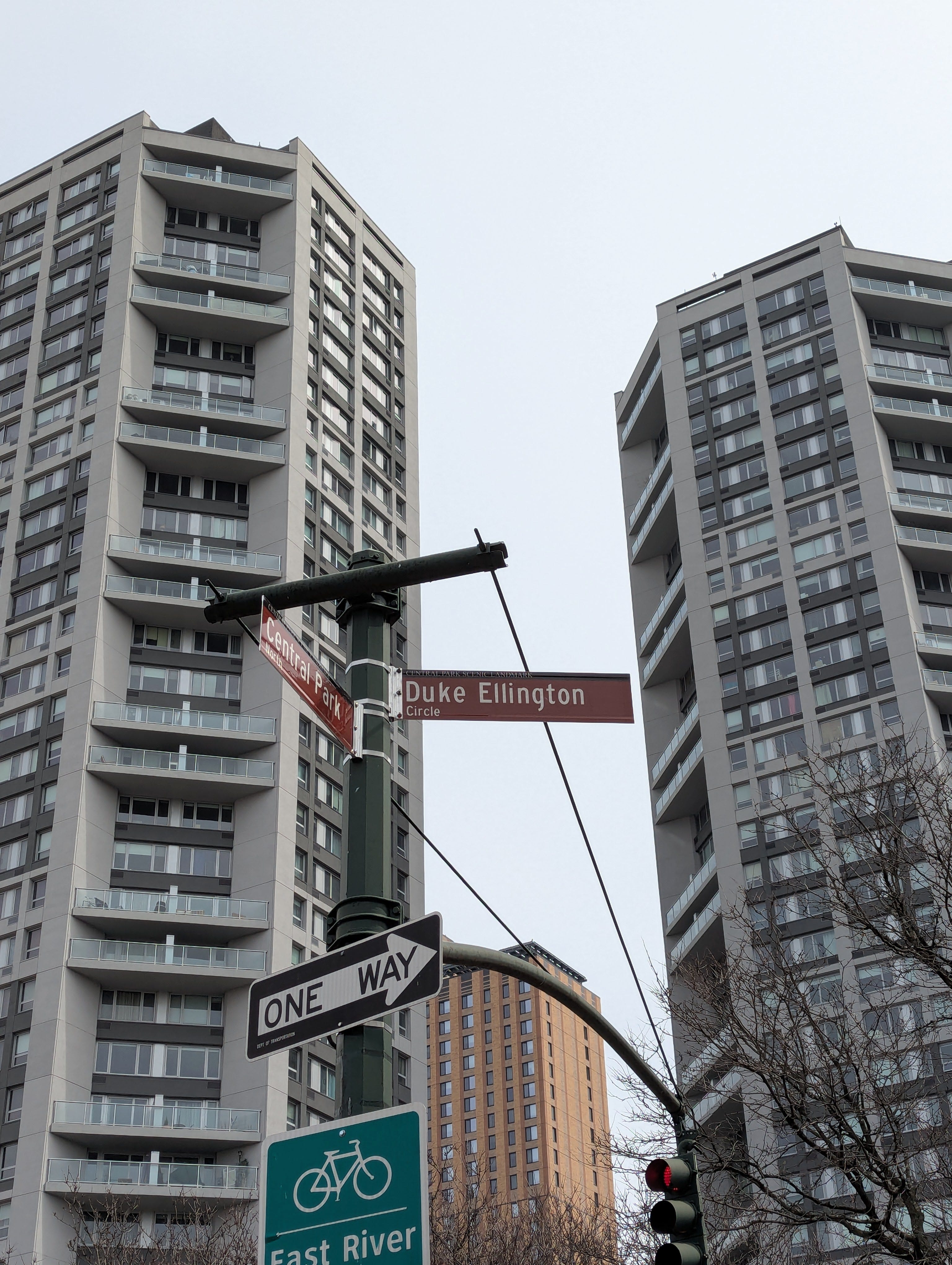
The Heritage
Having rested and written in my notebook, I walk the edge of Harlem, down Central Park North. See Towers on the Park (condos, late Modern: ‘88), then The Heritage (very ’74, very Ballard); three-grand a month, and right near the projects. This area is bum-rough, so I skip the Judge Dredd 1199 Plaza (1974) and get fancy down 5th Ave. Walk around the Guggenheim (1959), wonder if there’s any relation between FLW and Tim. I don’t pay to see exhibits, just lurk the gunite exterior and spiral lobby, look at the little details you don’t see in the photos: plastic bubble windows, punched circles, UFO shapes. Most amazing is the phone booths… which I suspect they must keep due to some historical mandate. The phones themselves are ripped out (with ugly wire left behind) but old fat phone books are still nestled flush in their metal binders; I’d look for Tim and Mary Ann’s number, but there’s too many pages, the pulp is starting to rot. Instead I get on the ground, look for the wads of stuck chewing gum, the cracks and the filth, the dirt under Frank Lloyd’s fingernails.


Guggenheim
Now I’m at the old Whitney (1966); Brutalist but with creeping Postmodernism, an upside-down ziggurat. (Turn it over, spell Laura like Loura, do whatever you want.) Designed by Marcel Breuer; back home he did the Cleveland Museum of Art’s annex (1970) and the Trust Tower (1971). Over at the Neue Gallery there’s Breuer chairs, Egon Schiele and Gustav Klimt. I look for a long long time.
***
I cross the park and head towards The Dakota (1884), do a quick Google search because I want to know the right spot. Private archway, West 72nd side, so I stand there, the spot where John was shot.
***
Back Uptown—my route has returned me to the Hungarian bakery and there’s still a goddamn line stretching out and down the sidewalk. I go across the street to the Children’s sculpture park and there’s a gnarly devil head; I think of the all-cement playgrounds in the Park, and how people used to have very different ideas about what is and isn’t appropriate for children. Head over to apartment, catch Rene on his way out. He smokes, but in that New York way; never seems to have a pack, and instead bums them off me or darts across the street to buy a loosey. Walk with him around neighborhood, then Riverside park (so many parks in New York). Back at apartment—look through things and feel like I’m snooping. Open a file cabinet and see Mr. Laughner’s last will and testament… the legalese granting Tim and Mary Ann the rights to Peter’s estate. Charlotte divorced Peter before he died, and Luke and Pat had no other children… why not give it all to Tim? After Luke died, Ubu’s David Thomas had reason to write to Tim (“I feel better now that a good company is looking after Peter’s legacy”). The email printout ends: “BTW, your computer’s date seems to be set to the year 1905.” I check the time stamp in the corner and see that this is true. And I don’t know if this is funny or scary; Tim once told Peter he wanted Pere Ubu to be a “telepathic time machine”…
Other items are less memento mori: A weird zine called “Poke A Dot” with a cover made of translucent graph paper; a bright red hardcover of The Beginning Was the End, one of the books that inspired DEVO; DVDs of Glenn O’Brien and Chris Stein’s public-access TV Party. I mention to Rene that O’Brien—of GQ and Interview fame—was originally from Cleveland. “What? Why are all these people from Cleveland?!” It’s a good question.


Various items from apartment
Get pizza for dinner. Hang with Rene back at apartment. Stay up too late talking, set phone alarm.
In the early morning, the city is still asleep.
***
Airport / New Jersey: Long delays and useless ICE agents. I’m killing time with my Nick Tosches and an oversized bag of Peanut M&Ms. As is always the case with short flights like this, more time is spent in the airport than in the air.
Back home and Valerie wants to hear about my trip, the cats want to circle my ankles. For some reason I skip Cleopatra, shrunken heads, DNA, Mother Goose, Adventure Playground. For some reason I go straight to a description of the crowded Hungarian bakery. My wife is quick to respond.
“These people have so little. New Yorkers are always waiting in long lines for some trendy pastry. Then they go back to their little apartments with with their tiny dogs and watch TV. New Yorkers watch more TV than anybody else I know.”
It’s good to be back in CLE.
A few days later, a package arrives from Avi: the DNA on DNA double-LP. I open the gatefold and recognize photos and fliers from Tim’s apartment. I look at the Glenn O’Brien liner notes from 2004 (“they were microwaving rhumbas and getting away with it”). I hold a slab of ghost-white vinyl.
I put the needle in the groove…
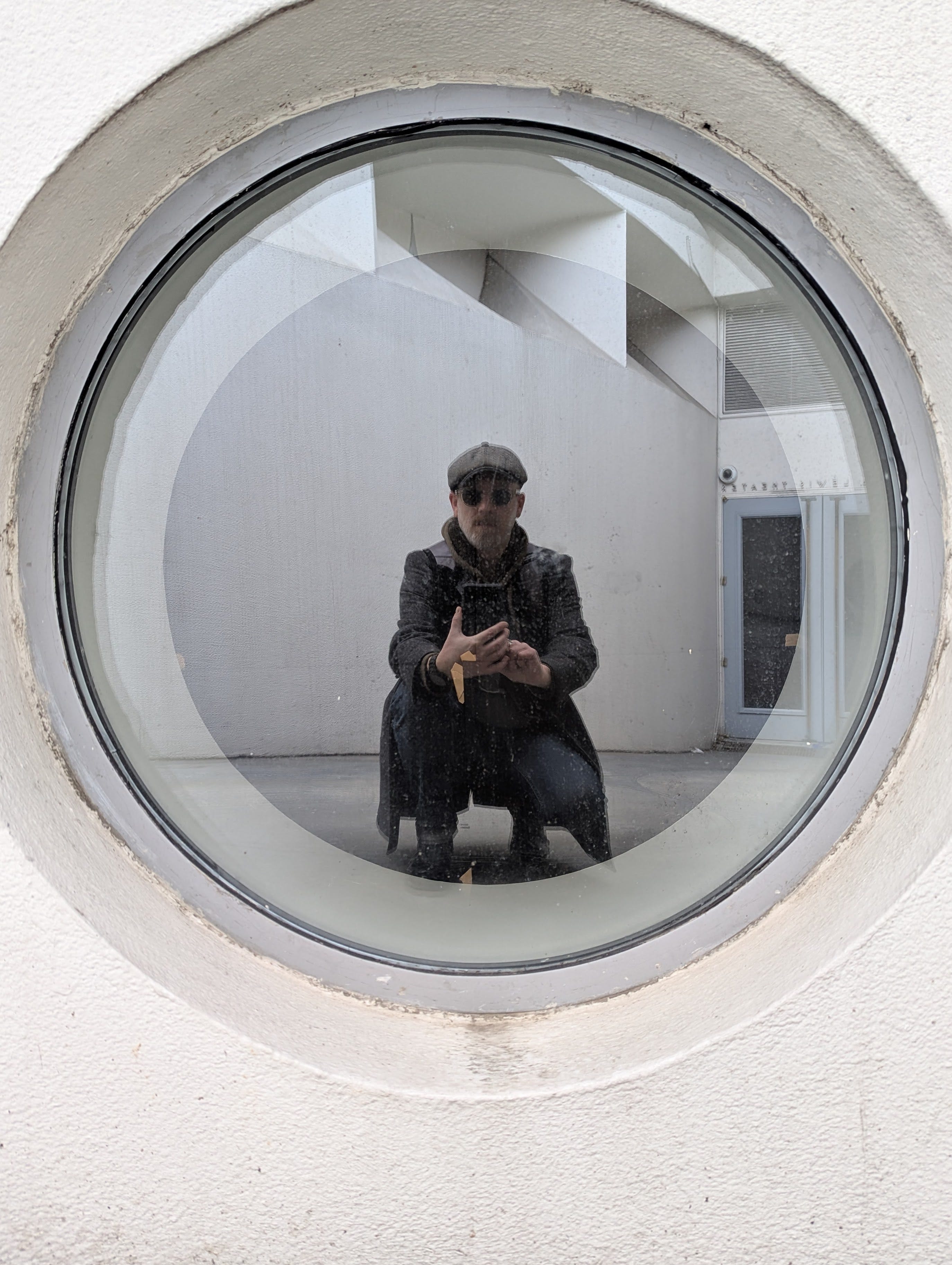
Selfie, Guggenheim Museum
THAT was a fantastic read. Thank you for your wonderful writings.
Great article. Fantastic read is correct.